Changing careers in Illinois as a veteran: what the public data actually shows.
You're seeing this with first.
Changing careers runs on two clocks at once. Over the long run, veterans' earnings tend to climb in the years after service. In the short run, a switch or a retraining program often costs a little first, before it pays off. This page shows both clocks honestly, side by side, so you can plan the gap instead of being surprised by it. What the data can't decide is whether the new work fits you. That part is yours.
Your trade-offs
Showing starting points for every value. Pick values on the main page to see yours highlighted here.
Money and security
| Value | What you'd gain | What you'd give up |
|---|---|---|
| Income / earning ceiling | A new field can have a higher ceiling than the one you're leaving. Some switches pay off within a few years. | Pay often dips first. You may start below where you are now and spend time climbing back. |
| Security / stability | Moving toward a steadier industry can lower your layoff risk. Federal contractors hire veterans more steadily than the market overall. | You trade seniority for being the new person again. New hires are often first out when work slows. |
| Getting out of debt | A higher-ceiling field can clear debt faster once you are established. | A pay dip or retraining cost usually slows payoff first. The budget gets tighter before it loosens. |
| Legacy / multi-generational | A field with room to grow builds skills, standing, and contacts you can pass on as experience. | Starting over resets standing you already earned. The climb begins again from a lower rung. |
Self-direction and growth
| Value | What you'd gain | What you'd give up |
|---|---|---|
| Autonomy / self-direction | Choosing the field yourself puts you back in charge of where your work is headed. | As the new person in a field, you have less say at first than you had where you held tenure. |
| Growth / learning | Strongest early. A switch forces fast learning of a whole new field. | The pace flattens once you are established. The expertise you built can sit unused while you catch up. |
| Mastery / craft | You can aim your craft at work that fits you better than the field you are leaving. | You trade hard-won expertise for being a beginner again. Mastery restarts in the new field. |
| Adventure / new experiences | A new field is genuinely new ground, with new people, tools, and problems. | The unknown cuts both ways. Novelty and uncertainty are the same thing here. |
People and connection
| Value | What you'd gain | What you'd give up |
|---|---|---|
| Family / partner / parenting time | A better-fit field can make you easier to live with at home. | A pay dip or retraining hours during the switch ask the whole household to absorb the gap. |
| Love / partnership | A partner who backs the move shares in a future that fits you better. | The lean stretch of a switch is carried by both of you. Money strain is a common pressure on couples. |
| Community / friendship | Veterans entering a new field often find veteran groups already there to help them land. | You leave behind the colleagues and standing of your old field. You rebuild your circle from scratch. |
Body, mind, and time
| Value | What you'd gain | What you'd give up |
|---|---|---|
| Physical health | Leaving a draining field can give back energy, sleep, and a steadier routine. | The stress of a switch and tighter money can crowd out training and rest while you settle in. |
| Mental health / stress | Work that fits better can lift the weight a wrong field puts on you. | Uncertainty during a switch is its own stress. The gap before the climb tests your patience. |
| Time / freedom of schedule | If you switch toward a steadier field, your hours can get more predictable. | A field switch is not a schedule switch. Early on you may put in extra hours to catch up. |
Meaning and service
| Value | What you'd gain | What you'd give up |
|---|---|---|
| Purpose / meaning | Aligning work with meaning is the most common reason veterans switch fields. | Purpose does not pay the gap. The data cannot promise the new field will feel as meaningful as you hope. |
| Faith / spiritual practice | A better-fit field can leave more room to honor your practice with a steady rhythm. | The busy, uncertain stretch of a switch can crowd out practice. Money stress tests discipline of every kind. |
| Service / impact | Switching toward a field that helps people directly, like health care or public service, can renew a sense of service. | The first months of a switch are mostly proving yourself, not serving. Impact arrives after you land. |
| Patriotism / love of country | Some fields, like federal contractors and public service, let veterans keep serving the country in civilian clothes. | Those fields can be slow to enter and paperwork-heavy. A switch does not fast-track you in. |
The value you added:
How would changing careers serve it, and what might it cost? Use the reflection questions below.
These are starting points, not scores. Nothing here is weighted or ranked for you.
The Illinois data
Four pictures, read in order: the long climb, which fields reward the move, the short-run dip, and how common changing employers really is at your stage.
The long climb: what Illinois veterans earn, 1 to 10 years after service
This is the spine. It follows Illinois veterans' civilian earnings at one, five, and ten years after they leave service. The line is the middle earner; the shaded band runs from the lower-earning quarter to the higher-earning quarter, so you can see the spread, not just the average.
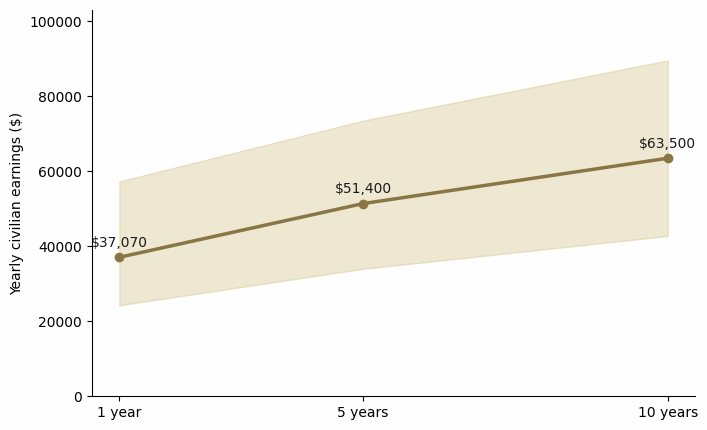
Illinois veterans' civilian earnings: the middle earner makes about $37,070 a year one year after service, $51,400 at five years, and $63,500 at ten. The shaded band is the middle half (25th to 75th percentile). All veterans, not only career-changers. [Source: U.S. Census Bureau, Veteran Employment Outcomes (VEO), v2.0.]
What this can and can't tell you: it covers all Illinois veterans, not only people who changed careers, so it shows where veterans land and climb in general. It can't tell you what any one switch pays.
Which fields reward the move (national)
Some fields pay veterans more than others five years on. This ranking is the part that is not Illinois-specific: the by-field numbers exist only nationally, so read it as the shape of the gap between fields, not as an Illinois paycheck.
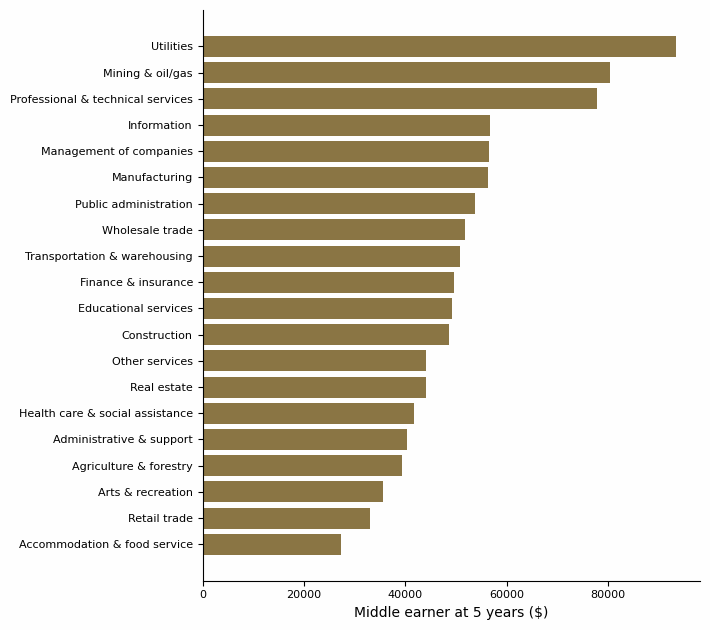
Veteran earnings five years out, by field, ranked. Highest: utilities near $93,430. Lowest: accommodation & food service near $27,220. National figures, not Illinois. The “unclassified” category is left off as not a real field. [Source: U.S. Census Bureau, Veteran Employment Outcomes (VEO), v2.0, national by industry.]
What this can and can't tell you: this is national, not Illinois. It shows which fields tend to reward veterans most five years in. It can't tell you the Illinois number for a specific field; the Illinois figure is the overall climb above.
The short run is flat: pay around a retraining program
The climb above is the long view. Here is the short view, and it is different. This compares the median quarterly wage just before an Illinois retraining program with the wage a few quarters after, for veterans who went through one. The first stretch is roughly flat, sometimes slightly down. That is the dip before the climb.
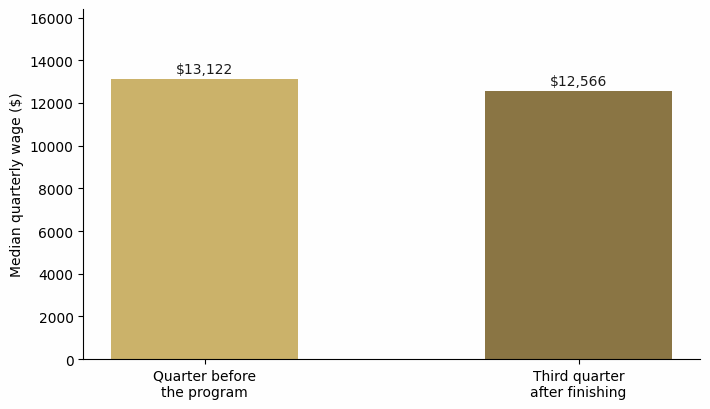
For the 2,084 Illinois veterans with a wage on both sides, the median quarterly wage was about $13,122 the quarter before a retraining program and about $12,566 three quarters after finishing: roughly flat. Wages are randomly adjusted for privacy, so only the aggregate is meaningful. [Source: U.S. Department of Labor, WIOA Performance Records (PIRL) public-use file.]
What this can and can't tell you: this is a small, specific group, Illinois veterans who went through a state retraining program, and the wages are randomly adjusted to protect privacy, so only the aggregate is real, never any one person's pay. It is a short-run, directional signal, not a precise number.
How common is changing employers at your stage?
If a move feels risky, here is some context. This shows the share of Illinois workers who move straight from one employer to another in a typical recent quarter, broken out by age. Changing employers is common, most so earlier in a career, and it never drops to zero.
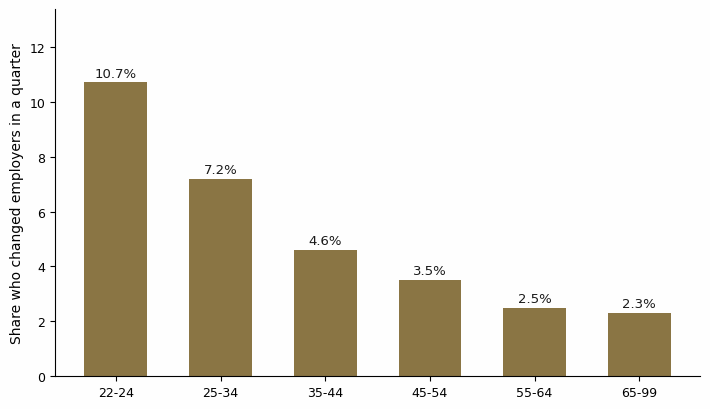
Share of Illinois workers who moved straight to a new employer in a typical recent quarter, by age. It runs from about 10.7% in the early-twenties band down to about 2.3% past 65, and never hits zero. All workers, not veterans only; this is employer change, not field change. [Source: U.S. Census Bureau, Longitudinal Employer-Household Dynamics (LEHD) Program, Job-to-Job Flows (J2J) data.]
What this can and can't tell you: this counts employer changes, not field changes, and it covers all Illinois workers, not veterans only. It answers "is changing employers normal at my stage," not "what does switching fields pay." No public Illinois data tracks veterans moving from one field to another.
Where your military skills already point
The by-field chart above is national. This is the part that can be Illinois-specific and personal. The O*NET® database, built by the U.S. Department of Labor, maps every military job to the civilian fields that lean on the same skills. Below are some common Army enlisted roles as examples, each matched to one civilian field that draws directly on it, with what it pays in Illinois and how much added training it usually takes. Find the family closest to your own service work.
-
logistics & supply e.g. 92Y Unit Supply Specialist
Transportation, Storage, and Distribution ManagersBright Outlook
$105,250 median pay, Illinois
Training to switch: Considerable: often a four-year degree
Skills you'd carry over:
- Active Listening
- Reading Comprehension
- Coordination
- Monitoring
-
medical & patient care e.g. 68W Combat Medic Specialist
Licensed Practical and Licensed Vocational Nurses
$66,030 median pay, Illinois
Training to switch: Medium: training, an apprenticeship, or a license
Skills you'd carry over:
- Service Orientation
- Coordination
- Social Perceptiveness
- Active Listening
-
IT & cybersecurity e.g. 25B Information Technology Specialist
Information Security AnalystsBright Outlook
$114,300 median pay, Illinois
Training to switch: Considerable: often a four-year degree
Skills you'd carry over:
- Reading Comprehension
- Critical Thinking
- Active Listening
- Complex Problem Solving
-
vehicle & equipment repair e.g. 91B Wheeled Vehicle Mechanic
Bus and Truck Mechanics and Diesel Engine Specialists
$62,750 median pay, Illinois
Training to switch: Medium: training, an apprenticeship, or a license
Skills you'd carry over:
- Repairing
- Troubleshooting
- Operations Monitoring
- Equipment Maintenance
-
human resources & admin e.g. 42A Human Resources Specialist
Human Resources SpecialistsBright Outlook
$72,350 median pay, Illinois
Training to switch: Considerable: often a four-year degree
Skills you'd carry over:
- Speaking
- Active Listening
- Reading Comprehension
- Critical Thinking
-
law enforcement & security e.g. 31B Military Police
Police and Sheriff's Patrol Officers
$101,530 median pay, Illinois
Training to switch: Medium: training, an apprenticeship, or a license
Skills you'd carry over:
- Active Listening
- Social Perceptiveness
- Speaking
- Active Learning
The O*NET data lists many civilian matches for each military job; this shows one that draws most directly on the role. The skills are the top-rated O*NET skills for that civilian field. Pay is the Illinois median for all workers in that field, not veterans only. Explore the full O*NET crosswalk for your own job code. [Sources: O*NET Web Services, U.S. Department of Labor (USDOL/ETA); Illinois pay from U.S. Bureau of Labor Statistics, OEWS.]
What this can and can't tell you: it shows that your military training already overlaps real civilian fields, and roughly how much added schooling or licensing each one tends to need. It can't promise you'll be hired into one, and your own service job may map to different fields. Use it as a starting map, not a destination.
This is information, not advice. You decide if it applies.
What tends to predict success
Each finding closes the same way on purpose: this is information, not advice. You decide if it applies.
-
More education tracks with higher pay and lower unemployment.
In the federal data, median weekly earnings rise at each step of education, and the unemployment rate falls. It is a pattern across workers, not a promise for any one person, and the cost and time of more schooling are part of the math. [U.S. Bureau of Labor Statistics, Education Pays.]
This is information, not advice. You decide if it applies.
-
A certification or license tracks with higher earnings.
Workers who hold a professional certification or license tend to earn more and face lower unemployment than workers without one. A credential is also portable, which can lower the risk of starting over in a new field. The benefit varies a lot by field. [U.S. Bureau of Labor Statistics data on certifications and licenses.]
This is information, not advice. You decide if it applies.
-
Some employers actually hire and keep veterans, not just pledge to.
The Department of Labor's HIRE Vets Medallion Award goes to employers that meet measured veteran hiring and retention thresholds, not a pledge on a careers page. The list of awardees is public, so you can see who clears a real bar. [U.S. Department of Labor, HIRE Vets Medallion Program.]
This is information, not advice. You decide if it applies.
-
Apprenticeships let you earn while you retrain, and most lead to a job.
A registered apprenticeship pays you while you learn, which can soften the short-run dip you saw above. The Labor Department reports that about 9 in 10 people who finish a registered apprenticeship stay employed afterward, with an average starting salary around $80,000. The GI Bill can cover many apprenticeships too. [U.S. Department of Labor, Veterans' Employment and Training Service, Registered Apprenticeship.]
This is information, not advice. You decide if it applies.
-
Switching into a growing field can lower the risk.
Some of the fields your skills point toward are projected to grow much faster than others, which usually means more openings if you switch. Information security work, for example, is projected to grow about 29 percent over the coming decade, against about 3 percent for all jobs on average. The "Bright Outlook" tags in the skills section above flag fields the government expects to grow fast or hire heavily. [U.S. Bureau of Labor Statistics, Employment Projections, 2024 to 2034.]
This is information, not advice. You decide if it applies.
More research: another thing that tends to move the odds
Same rule as above: all of this is information, not advice. You decide what applies.
Your military training may count toward a civilian license. Most occupational licenses are issued by states, and a growing number let veterans apply military training and experience toward the requirements, so you may not have to start from zero for fields like commercial driving, emergency medical work, or health care. What counts varies by state and by license. [U.S. Department of Labor, Veterans' Employment and Training Service, license recognition; CareerOneStop License Finder.]
The skills side of "what makes a switch work" has its own section above: where your military skills already point, drawn from the U.S. Labor Department's O*NET data. Every finding here shares one honest limit: it describes patterns across many workers, not a forecast for you.
Timing that might matter
These show up only when they apply to what you've told the page. If nothing appears, none were triggered.
Re-entry after a long gap gets harder after 45
Long gaps out of the workforce are harder to recover from after 45. Among unemployed workers 55 and older, nearly half stay job-hunting six months or more, and research that followed older workers after an involuntary job loss found only about 1 in 10 ever got back to their prior pay. If you're weighing a multi-year training pause, plan how you'll keep your employability signal alive during the gap.
[Georgetown University Center for Retirement Initiatives, summarizing Urban Institute and Bureau of Labor Statistics research.]
This is information, not advice. You decide if it applies to your situation.
Your education-benefit clock
Your separation year changes your benefit clock. If you separated before January 1, 2013, your Post-9/11 GI Bill expires 15 years after your last separation, and Veteran Readiness and Employment (VR&E) gives you 12 years from separation or your first VA disability rating, whichever is later. If you separated on or after January 1, 2013, neither clock applies: the Post-9/11 GI Bill never expires (Forever GI Bill) and VR&E has no time limit either. Check your specific timeline at VA.gov.
[VA.gov, Post-9/11 GI Bill and Veteran Readiness and Employment (VR&E) eligibility pages.]
This is information, not advice. You decide if it applies to your situation.
Tell the page your age band or separation year on the main page and any timing notes that fit will appear here.
What I can't show you
- There's no public Illinois data that tracks veterans moving from one field to another, so I can't show the most common switch routes or what a specific Illinois switch pays.
- The by-field pay (the second chart) is national, not Illinois. The Illinois-specific number is the overall climb, not the by-field detail.
- The climb (the first chart) is all veterans, not only career-changers. It includes people who never switched fields.
- The short-run program data is a small, special group with randomly adjusted wages, measured only a few quarters out. It's directional, not exact.
- The skills bridge above uses a handful of common Army jobs as examples and matches each to one civilian field. It can't cover every military job, every service branch, or every field your skills might fit, and the matches come from a national skills database, so your own role may map differently.
- None of this measures fit, drive, or whether your household can carry a lean stretch. No dataset can.
Should you stay or go?
If your goal might be better served in another state, here is an honest comparison with the states veterans often weigh against Illinois: California, Texas, Colorado, and Washington. First, what the six fields from the skills bridge pay in each. Then, for the time-and-freedom focus, how common working from home is.
What the fields pay, by state
| Field | Illinois | California | Texas | Colorado | Washington |
|---|---|---|---|---|---|
| Logistics managers | $105,250 | $104,930 | $97,690 | $123,750 | $131,620 |
| Licensed practical nurses | $66,030 | $77,170 | $60,150 | $67,480 | $79,700 |
| Information security analysts | $114,300 | $140,660 | $124,970 | $130,570 | $142,920 |
| Diesel & truck mechanics | $62,750 | $70,650 | $57,870 | $66,330 | $76,940 |
| HR specialists | $72,350 | $81,810 | $64,560 | $78,170 | $83,230 |
| Police officers | $101,530 | $115,400 | $76,350 | $96,100 | $102,640 |
Median yearly pay for all workers in each field, not veterans only. These are wages before cost of living and taxes, which differ a lot between states, so a bigger number is not automatically a better deal. [Source: U.S. Bureau of Labor Statistics, OEWS, May 2024.]
How common working from home is
Share of workers who worked from home in 2024. A rough read on flexibility, not a promise that any specific job is remote. [Source: U.S. Census Bureau, American Community Survey 2024, table B08006.]
Weighing a specific state I didn't include? Tell me in the signup below and I'll prioritize it.
Taxes change with your state
Where you legally reside changes how your military retirement and VA disability income are taxed, and what property-tax breaks you qualify for. Illinois doesn't tax retirement income, including military retirement. Texas and Florida have no state income tax, and both offer up to a full homestead property-tax exemption for 100% disabled veterans. California still taxes military retirement above a partial exclusion (up to $20,000 a year starting with tax year 2025, with income limits, and that provision is set to expire before 2030). If "should you stay or go" is a real question for you, the tax math is part of the answer. Verify against each state's revenue department before you decide.
[Illinois Department of Revenue; Texas Comptroller; Florida Statutes; MOAA state tax updates. Verify with each state's revenue department.]
This is information, not advice. You decide if it applies to your situation.
An honest check before you decide
- If the new field pays less at first, how many lean months can your household absorb before it hurts?
- What would you have to give up to retrain or start over, and is that a price you're willing to pay?
- Who else carries this with you, and have you actually talked it through with them?
Skill-builder is a preview right now. Want the full version when it ships? Go to Skill-builder and drop your email there.
Before you go
Was this useful?
Your Yes/No tells me whether to keep building these.
The sign-up form needs JavaScript turned on in your browser.
☕ Buy me a coffee · offsets the data and build costs. Optional.