Starting a business in Illinois as a veteran: what the public data actually shows.
You're seeing this with first.
Government filings tell us who hires veterans, which sectors survive, and what programs exist. They don't tell us whether you'll like the work, whether your family can ride out lean months, or whether you're built for it. That part is yours.
Your trade-offs
Showing starting points for every value. Pick values on the main page to see yours highlighted here.
Money and security
| Value | What you'd gain | What you'd give up |
|---|---|---|
| Income / earning ceiling | No salary cap. Equity in something you own builds over years. | No income floor. Cash gaps in the first one to three years are typical. |
| Security / stability | A long-run asset if the business survives. Nobody can lay you off. | Steady pay traded for variance now. The safety net is whatever you built. |
| Getting out of debt | A higher long-run ceiling can clear debt faster later. | Payoff usually slows first. Many founders take on new business debt before old debt is gone. |
| Legacy / multi-generational | A business can outlive a career and pass to family. | Most don't survive long enough to transfer. Your family may inherit debts, not assets. |
Self-direction and growth
| Value | What you'd gain | What you'd give up |
|---|---|---|
| Autonomy / self-direction | You set direction and pace. Every call is yours. | You own every failure too. Customers and cash flow become your new chain of command. |
| Growth / learning | Forced growth across every function: sales, money, operations, people. | Depth in your current craft can stall while you learn everything else. |
| Mastery / craft | You choose the work, so you can choose work that sharpens your craft. | Founders spend most hours running the business, not practicing the craft it's built on. |
| Adventure / new experiences | Few work lives change more week to week than a founder's first years. | The adventure doesn't clock out. Novelty and instability are the same thing here. |
People and connection
| Value | What you'd gain | What you'd give up |
|---|---|---|
| Family / partner / parenting time | Schedule control: you can be at school pickup, and no boss can deny you that. | The business follows you home. Lean months stress the whole household, not just you. |
| Love / partnership | A partner who shares the mission can grow closer through the build. | Financial strain and long hours are among the most common pressures couples report. Your partner carries this bet with you. |
| Community / friendship | Veteran founder networks are real and active: Bunker Labs, SCORE, local chambers. | Time for old friendships usually shrinks in the first years. Founding can be lonely. |
Body, mind, and time
| Value | What you'd gain | What you'd give up |
|---|---|---|
| Physical health | Your calendar, so training and sleep can fit if you protect them. | Founders commonly report worse sleep and dropped routines in the first years. Nobody schedules your recovery. |
| Mental health / stress | Work that matches your purpose can lift the weight a wrong job puts on you. | Uncertainty is constant. Revenue stress doesn't take weekends. Founders who last tend to know their warning signs. |
| Time / freedom of schedule | You choose the hours. No one else's meeting can claim your morning. | Early on, you'll likely work more total hours than any job asked of you. Freedom of schedule is not fewer hours. |
Meaning and service
| Value | What you'd gain | What you'd give up |
|---|---|---|
| Purpose / meaning | The mission is yours. Many veterans say founding restored direction they missed after service. | When the mission struggles, it's personal. There's no rotation off this deployment. |
| Faith / spiritual practice | Schedule control to honor your practice consistently. | The ups and downs of the first years can crowd out practice. Money stress tests discipline of every kind. |
| Service / impact | A business can serve people directly: jobs created, problems solved, veterans hired. | Impact arrives slowly. The first years are mostly survival, not service. |
| Patriotism / love of country | Veteran-owned businesses can serve the country again through federal work. Service-Disabled Veteran-Owned Small Business (SDVOSB) set-asides exist for this. | Federal contracting is slow, paperwork-heavy, and competitive. The flag on the website doesn't win bids. |
The value you added:
How would founding serve it, and what might it cost? Use the reflection questions below.
These are starting points, not scores. Nothing here is weighted or ranked for you.
The Illinois data
One breakdown at a time. Where a group's survey sample is too small to publish reliably (under 30 respondents), that slice is left out and the chart says so.
Research note for women veterans: business-training programs (Small Business Development Centers, Bunker Labs, and Entrepreneurship Bootcamp for Veterans) show a notably stronger benefit for women who complete them. Full citation in "More research" below.
Where Illinois veterans work, by industry
Read this as a founder, not a job-seeker. Veteran-dense industries are where your experience already fits, where veteran hires are easiest to find, and where your network runs deepest. Survival rates by industry are in the research section below. Illinois doesn't publish survival for veteran-owned firms separately; see "What I can't show you."
1 of 20 industries are not shown for this group: their survey sample is under 30 respondents, the floor for publishing a reliable estimate.
1 of 20 industries are not shown for this group: their survey sample is under 30 respondents, the floor for publishing a reliable estimate.
Men: 181,304 employed veterans (five-year average).
9 of 19 industries are not shown for this group: their survey sample is under 30 respondents, the floor for publishing a reliable estimate.
Women: 24,349 employed veterans (five-year average).
6 of 20 industries are not shown for this group: their survey sample is under 30 respondents, the floor for publishing a reliable estimate.
Under 35: 29,268 employed veterans (five-year average).
6 of 20 industries are not shown for this group: their survey sample is under 30 respondents, the floor for publishing a reliable estimate.
35 to 44: 41,188 employed veterans (five-year average).
1 of 20 industries are not shown for this group: their survey sample is under 30 respondents, the floor for publishing a reliable estimate.
45 and older: 135,197 employed veterans (five-year average).
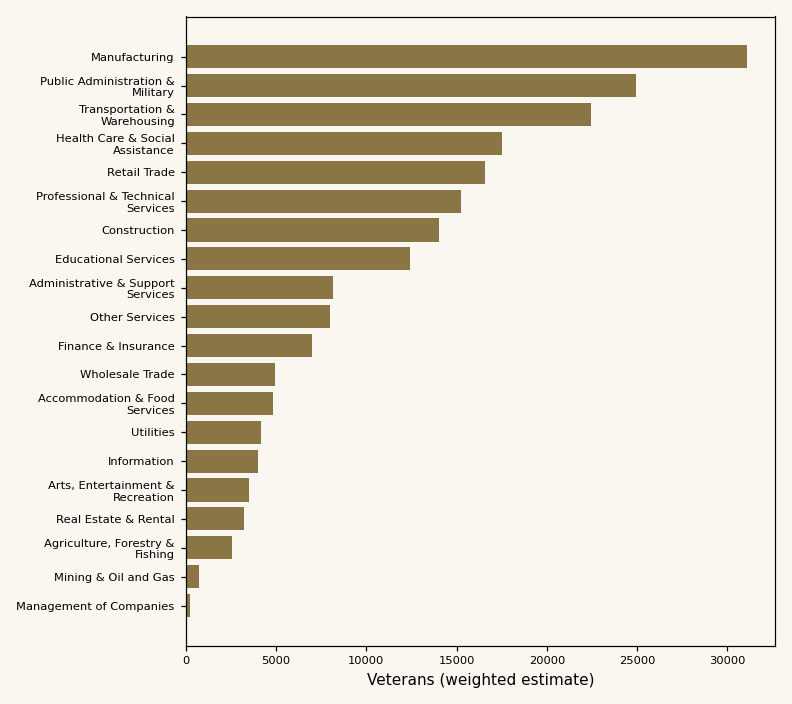
Industries where Illinois veterans work, by estimated share. Source: U.S. Census Bureau American Community Survey (ACS), 2020-2024 five-year Public Use Microdata Sample (PUMS). This covers all employed veterans, not only federal-contractor employees. Employed veterans in this estimate (five-year average): 205,653. Group views show only industries with at least 30 survey respondents (suppression floor); hover percentages are out of the displayed group's total. [Source: U.S. Census Bureau; industry grouping detail in the methodology.]
Where Illinois veterans live, by county
For a founder, this is a customer and talent map: where veteran customers cluster, and where veteran hires live.
County shares for men and women use the same Census table as the main map. Counties where the group's veteran estimate is under 50 show as gray (too small to publish reliably); the count is in the hover. Small-county estimates for women veterans carry wide margins of error.
The county map can't break down by these age bands: the Census county table uses different age groups. The industry chart above can.
Veterans as a share of civilian adults (age 18 and over) by Illinois county. Source: Census ACS 2020-2024 five-year estimate, Table B21001. The five-year estimate pools 2020 through 2024 survey data to produce reliable county-level figures. Top five counties by veteran count: Cook (132,321), Will (25,531), DuPage (25,169), Lake (25,130), St. Clair (21,939). Shading reflects veteran share of adults; the darkest counties have the highest share, not always the highest headcount. County names come straight from the Census map files; I don't modify them.
What Illinois jobs pay
Two ways to read wages as a founder: this is the salary you'd give up, and it's roughly what you'll pay when you hire.
Wages here can't be broken down by gender or age: the federal wage survey publishes industry totals, not worker demographics. The table shows all workers.
| Industry | Protected-veteran employees reported (2024-25) | IL 25th percentile | IL median | IL 75th percentile |
|---|---|---|---|---|
| Professional, Scientific, and Technical Services | 11,160 | $39.50 | $55.40 | $76.66 |
| Transportation (48) | 10,442 | $19.01 | $22.19 | $26.46 |
| Administrative and Support and Waste Management | 5,164 | $17.23 | $19.57 | $23.14 |
| Utilities | 4,818 | $33.66 | $40.80 | $49.32 |
| Information | 4,388 | $29.20 | $38.77 | $53.48 |
| Wholesale Trade | 4,266 | $22.45 | $29.22 | $40.83 |
| Educational Services | 4,184 | $15.59 | $18.43 | $20.56 |
| Manufacturing (31) | 3,802 | $19.67 | $22.97 | $27.60 |
| Finance and Insurance | 3,728 | $29.12 | $37.01 | $52.30 |
| Health Care and Social Assistance | 3,404 | $22.22 | $24.82 | $27.46 |
| Accommodation and Food Services | 2,884 | $14.93 | $16.18 | $18.94 |
| Construction | 2,564 | $29.12 | $41.75 | $52.63 |
These wages cover all Illinois workers in each sector, not veterans only. They come from the Bureau of Labor Statistics (BLS) wage survey, May 2024 release. Veteran pay may be higher or lower. The sectors shown are where companies with federal contracts reported the most veteran employees. These companies are only part of all employers in each sector. Some industries appear more than once. The federal code list splits them.
The top-25 federal contractors, read as a founder
The 2025 federal-contractor filings list the largest prime contractors hiring veterans in Illinois. For a founder weighing federal work, that table is not a list of employers. It's a list of potential customers. Contractors that size are required to send a share of their work to small businesses, and service-disabled veteran-owned firms are one of the groups they look for to meet that requirement. That's why the table reads differently on this path: it's a map of who buys what you'd sell.
What tends to predict success
Each finding closes the same way on purpose: this is information, not advice. You decide if it applies.
-
Sector choice moves the odds.
About 57 percent of new health care firms are still in business five years after founding. For transportation and information firms it's about 46 to 46 percent. The gap between industries holds across different founding years. The chart below shows all 19 industries. [U.S. Census Bureau Business Dynamics Statistics; computed for this page, math in the methodology.]
This is information, not advice. You decide if it applies.
-
SBA-backed financing tracks with higher survival.
Businesses with Small Business Administration (SBA) backed loans survive at higher rates than matched businesses without them. [SBA lending data; peer-reviewed study cited in the methodology.]
This is information, not advice. You decide if it applies.
-
Founder experience moves the odds.
Roughly 18 percent of first-time founders are still in business at five years. For founders with a prior failure it's roughly 20 percent; with a prior success, roughly 30 percent. [Equidam meta-analysis.]
This is information, not advice. You decide if it applies.
-
Service and product businesses behave differently.
Service businesses cost less to start and earn sooner, but revenue tracks the founder's hours. Product businesses cost more and take longer, but revenue can scale past your hours. Veteran federal set-asides concentrate in service industries. [U.S. Chamber of Commerce founder research; full citation in the methodology.]
This is information, not advice. You decide if it applies.
-
SBA Mentor-Protégé participation opens doors.
Across multiple studies of small firms, mentored businesses outperform non-mentored ones on revenue growth and profitability. The SBA Mentor-Protégé program is built for federal-contracting protégés, and its directory of active mentors is public. [Small-business mentoring meta-analysis; SBA Mentor-Protégé program documentation.]
This is information, not advice. You decide if it applies.
New-business survival by industry, five years in
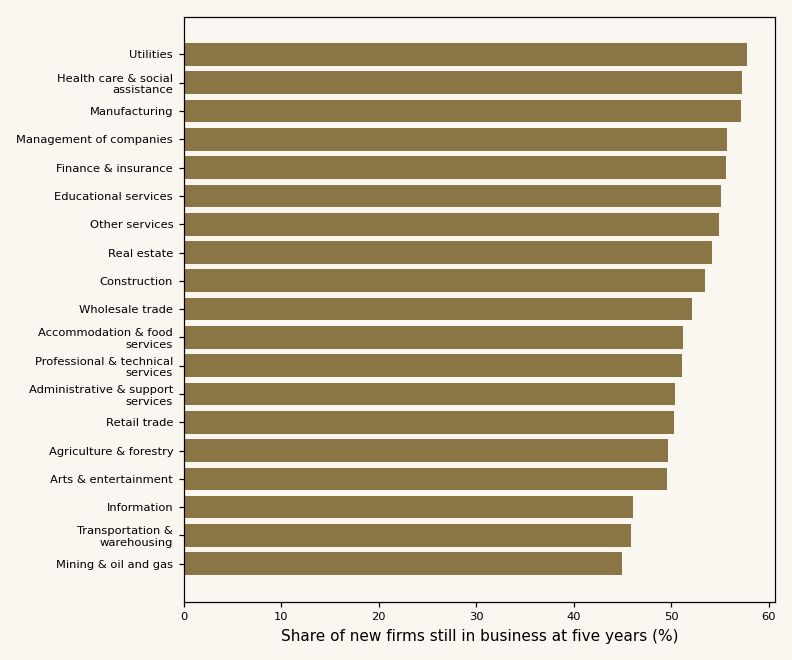
Share of new firms still in business five years after founding, by industry. All founders nationwide, not veterans only. Average of firms founded 2015 to 2017 (reaching year five in 2020 to 2022); the ranking is stable for earlier founding years too. A firm bought by another company counts as closed here, even if the business lives on. [Source: U.S. Census Bureau Business Dynamics Statistics (BDS), national firm counts by firm age.]
More research: 9 additional findings, with weaker or more situational evidence
Same rule as above: all of this is information, not advice. You decide what applies.
-
Who you start the business with matters.
Founding teams whose members bring different work histories, and who have also worked together before, survive at higher rates than teams with only one of those traits. Military service itself counts as shared experience. This shows a pattern, not proof of cause; it comes from a large Census employment dataset. [Wisconsin School of Business, 2025, using Census data.]
-
Leaning on one big contract is fragile.
People who study government contractors advise keeping any single customer under about half of your revenue in the early years. One lost or re-competed contract should not be able to end the company. This is practitioner consensus, not large-scale research. [Naval Postgraduate School research on contract success factors.]
-
Solo, employer, or subcontractor changes the time math.
Working solo gives the most schedule control, with revenue capped at your own hours. Hiring scales revenue but adds management load. Subcontracting to larger primes grows revenue without carrying the full overhead. This describes how the models work, not proof of cause. [SBA Office of Advocacy self-employment time-use research, 2025.]
-
Industry rhythm shapes founder hours.
Industries that run on projects and contracts, like consulting and security services, tend to allow more predictable founder hours than always-on industries like food service and retail. This is inferred from how the work is structured; direct time studies by industry are rare. [Bureau of Labor Statistics industry data.]
-
Founders do better near other founders.
Regions with more veteran-owned firms, military installations nearby, and active mentor programs give founders peer networks to draw on. This shows a pattern, not proof of cause. [Kauffman Foundation state entrepreneurship report, 2021.]
-
Past performance is the federal gate.
Federal buyers score your record of past contract work. The documented way in: start small under Simplified Acquisition Procedures, build a record, then scale up. Practitioner consensus, backed by written federal policy. [Federal-contracting practitioner guides; SAM.gov.]
-
CMMC is a later-stage cybersecurity gate.
New Department of Defense contracts require a validated Cybersecurity Maturity Model Certification (CMMC) self-assessment; Level 2 bidders need a score of at least 88 out of 110. This matters when you bid Defense work directly. It is not a day-one requirement for most founders. The rule is new, so evidence on win rates isn't mature yet. [Washington Technology CMMC analysis, 2026.]
-
Management certifications are a cost decision, not a proven edge.
Credentials like Project Management Professional (PMP) and Lean Six Sigma signal management discipline that federal customers say they value, and they translate military project experience into civilian terms. Direct research tying them to founder success is thin. The cost and study time are part of the math, not just the badge. [Practitioner guidance; certification program documentation.]
-
Structured training programs build confidence and plans.
Programs like Small Business Development Centers (SBDC), Bunker Labs, and the Entrepreneurship Bootcamp for Veterans raise founder confidence and planning discipline. The measured benefit is notably stronger for women who complete them. Long-term impact on survival is not established. [Small Business Institute Journal program evaluation; effect-size detail in the methodology.]
Timing that might matter
Federal certification and the year-end window
If federal contracting is part of your plan: Service-Disabled Veteran-Owned Small Business (SDVOSB) certification runs through the Small Business Administration's VetCert portal (it moved there from the VA in January 2023). The SBA doesn't publish a standard processing time, so the realistic lead time is months, not weeks. Timing matters because the federal fiscal year ends September 30, and agencies commit a large share of their contract money in the final quarter (July through September). Founders aiming at that window start certification months ahead of summer.
[Small Business Administration (SBA) VetCert program documentation; Liebman and Mahoney, American Economic Review (2017), on federal year-end spending.]
This is information, not advice. You decide if it applies to your situation.
Your health-coverage bridge after separation
Military health coverage ends at separation, and the bridge is narrower than most people expect. The Transitional Assistance Management Program (TAMP) provides 180 days of premium-free TRICARE after separation, but only for certain categories (involuntary separation under honorable conditions, post-contingency-operation service, and a few others). VA health care enrollment is separate and not automatic. Coverage gaps during a business launch or a job search are common and avoidable: your specific window is verifiable at TRICARE.mil and VA.gov before your separation date, not after.
[TRICARE.mil, Transitional Assistance Management Program (TAMP); VA.gov health care enrollment.]
This is information, not advice. You decide if it applies to your situation.
Your education-benefit clock
Your separation year changes your benefit clock. If you separated before January 1, 2013, your Post-9/11 GI Bill expires 15 years after your last separation, and Veteran Readiness and Employment (VR&E) gives you 12 years from separation or your first VA disability rating, whichever is later. If you separated on or after January 1, 2013, neither clock applies: the Post-9/11 GI Bill never expires (Forever GI Bill) and VR&E has no time limit either. Check your specific timeline at VA.gov.
[VA.gov, Post-9/11 GI Bill and Veteran Readiness and Employment (VR&E) eligibility pages.]
This is information, not advice. You decide if it applies to your situation.
The caregiving years
If you have aging parents, caregiving demand often peaks while parents are in their late 70s and 80s. Nearly half of care recipients are 75 or older, and the typical family caregiver is around 50: the same years most careers peak. Those two clocks often run at the same time.
[National Alliance for Caregiving and AARP, Caregiving in the U.S. 2025.]
This is information, not advice. You decide if it applies to your situation.
What I can't show you
- SAM.gov doesn't expose veteran ownership cleanly at the firm level.
- The SBA's Service-Disabled Veteran-Owned Small Business (SDVOSB) directory lags real certification status.
- Most survival research is national. Illinois-specific small-business survival by veteran status isn't separately published.
- None of this measures fit, drive, or whether your household can carry the risk. No dataset can.
Should you stay or go?
If your goal might be better served in another state, Illinois needs an honest comparison with where veterans most often relocate: Texas, California, Florida, Tennessee, and Colorado.
| Factor | IL | TX | CA | FL | TN | CO |
|---|---|---|---|---|---|---|
| Veteran-owned share of employer businesses (2022) | 3.4% | 5.1% | 3.5% | 4.9% | 5.0% | 5.4% |
| Workers who are self-employed (2024) | 9.0% | 10.7% | 11.6% | 13.0% | 9.9% | 11.5% |
| SBA-certified SDVOSB firms (June 2026) | 702 | 4,031 | 2,761 | 3,796 | 717 | 872 |
| Active SBA Mentor-Protégé agreements (May 2026) | 34 | 117 | 88 | 129 | 37 | 32 |
Sources: veteran-owned share from the U.S. Census Annual Business Survey (ABS), 2022, businesses with employees only; self-employment from the American Community Survey (ACS) 2020-2024 five-year estimate, all workers; SDVOSB counts from the SBA's certification search at search.certifications.sba.gov, retrieved June 11, 2026; Mentor-Protégé counts from the SBA's active-agreements list effective May 5, 2026, counted by protégé state. The last two rows are raw counts, not rates: larger states naturally have more firms.
Plain read: Illinois currently has the lowest veteran-owned business share and the lowest self-employment rate of these six states. The reasons matter (industry mix, cost, taxes), but the gap itself is real.
Weighing a state that's not here? Tell me in the signup below and I'll prioritize it.
Taxes change with your state
Where you legally reside changes how your military retirement and VA disability income are taxed, and what property-tax breaks you qualify for. Illinois doesn't tax retirement income, including military retirement. Texas and Florida have no state income tax, and both offer up to a full homestead property-tax exemption for 100% disabled veterans. California still taxes military retirement above a partial exclusion (up to $20,000 a year starting with tax year 2025, with income limits, and that provision is set to expire before 2030). If "should you stay or go" is a real question for you, the tax math is part of the answer. Verify against each state's revenue department before you decide.
[Illinois Department of Revenue; Texas Comptroller; Florida Statutes; MOAA state tax updates. Verify with each state's revenue department.]
This is information, not advice. You decide if it applies to your situation.
An honest check before you decide
- What can you afford to lose if this doesn't work: money, career runway, relationships?
- How long can you go on reduced or zero income before you have to pivot?
- Who else carries this risk with you, and have you actually talked to them about it?
Skill-builder is a preview right now. Want the full version when it ships? Go to Skill-builder and drop your email there.
Before you go
Was this useful?
Your Yes/No tells me whether to keep building these.
The sign-up form needs JavaScript turned on in your browser.
☕ Buy me a coffee · offsets the data and build costs. Optional.